
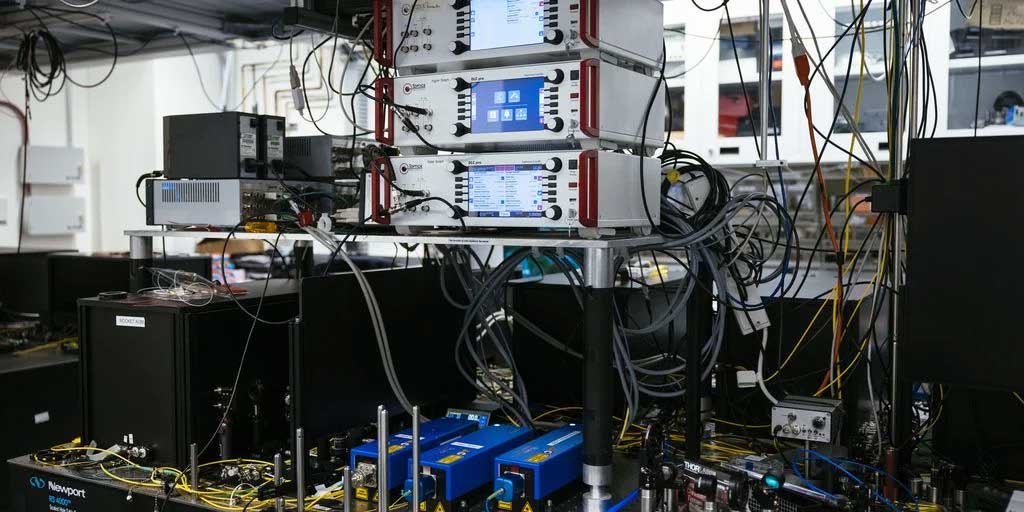
In 2025, U.S. computing labs are undergoing a revolution that could redefine the future of computing—not through better chips, but through fundamentally new materials. Scientists are pioneering quantum materials—engineered substances whose exotic electronic, magnetic, and superconductive properties are essential for building practical quantum computers. This wave of innovation is supported by national laboratories, universities, and private industry, all converging to turn laboratories into quantum foundries.
1. 🚩 What Are Quantum Materials—and Why They Matter
Quantum materials harness peculiar quantum phenomena—like superconductivity, spin polarization, and topological order—that emerge only at atomic scales. Unlike silicon, they can sustain quantum states robustly:
- Superconductors enable lossless current flow and are central to superconducting qubits.
- Topological materials, such as Majorana-supporting semiconductors, offer inherently error-resistant qubits.
- Strained 2D materials can be switched between conventional and quantum states, a foundation for quantum control.
These materials promise to deliver longer coherence times, lower error rates, and scalable platforms—critical for achieving practical quantum computing. Without them, purely architectural advances fall short.
2. 🏛 U.S. National Labs Leading the Charge
SQMS at Fermilab & NIST
Led by Fermilab and NIST, the Superconducting Quantum Materials and Systems (SQMS) Center focuses on enhancing qubit performance via advanced materials fabrication.
Recent breakthroughs include encapsulating niobium qubits with tantalum/gold, yielding coherence times up to 0.6 ms, a major leap for superconducting systems
This research addresses a pivotal bottleneck—minimizing decoherence from oxide surfaces—thereby advancing scalable qubit hardware.
Q-NEXT and Quantum Foundries
Q-NEXT, headquartered at Argonne National Lab and partnered with Stanford, is laying the groundwork for “quantum foundries”—centralized facilities to fabricate, standardize, and characterize quantum-grade materials . This supply-chain mentality ensures consistency and interoperability across quantum hardware.
3. 🏫 University Breakthroughs: UCI’s Strain Platforms
At the University of California–Irvine, researchers demonstrated strain-engineering in hafnium pentatelluride—stretching the material into a conductive, quantum-appropriate state By applying controlled stress at the atomic scale, they effectively “poke holes” in the material structure to switch its quantum properties on and off—an essential capability for future device controls.
This level of fine-grained manipulation brings lab curiosity closer to industrially viable quantum component production.
4. 🌐 Public-Private Ecosystem: U.S. Quantum Clusters
Beyond federal labs, coordinated hubs are forming:
- UCLA’s Quantum Science & Engineering Center plans a large-scale innovation campus—reimagining labs within a public-private accelerator environment
- Quantum New Mexico Institute and Colorado’s Elevate Quantum tech hub are cultivating regional clusters linking universities, labs, and startups, backed by federal and local funding ($40M+ investments each)
These clusters fuel both workforce development and commercialization, preparing the path from bench to marketplace.
5. 🏢 Industry Engagement & Scaling
Microsoft’s Majorana Breakthrough
In early 2025, Microsoft revealed the Majorana‑1 chip—an indium arsenide–aluminum device demonstrating promising Majorana zero-mode signals These topologically protected qubits could lead to inherently error-resistant quantum hardware, sidestepping the need for enormous error correction.
Tech Giants & DOE Partnerships
Companies like IonQ (scale-up plans to >2 million qubits by 2030) and DARPA’s benchmarks for HPE labs signal a push from both private and defense sectors to integrate quantum materials into full-stack systems
These efforts underscore the urgency around materials readiness for quantum architecture.
6. 🔧 Quantum Materials in Action: Real-World Demonstrations
Google’s Willow Processor
Google’s Willow 105-qubit superconducting chip was built using advanced materials design to reduce errors exponentially at scale—marking a major step toward fault-tolerant hardware
D-Wave’s Advantage2
Using quantum annealing, D-Wave’s systems (7,000+ qubits) demonstrated material science simulations faster than top classical supercomputers, showcasing the practical utility of tailored quantum materials in optimization tasks
7. 🎯 Challenges Ahead: Material, Fabrication, Integration
Despite momentum, key challenges loom:
- Defect Control: Quantum performance depends on atomic-level purity; small errors destroy coherence. National labs prioritize defect characterization and cleanroom capabilities.
- Interoperability: Standardizing materials across superconducting, topological, photonic, and spin-qubit platforms demands cross-institutional coordination.
- Scale vs. Quality: Building a million‑qubit machine demands material repeatability and uniformity—where traditional semiconductor fabs may lack the precision quantum demands.
8. 🗺 Strategy: How the U.S. Is Building Leadership
The U.S. approach hinges on a multi-pronged strategy:
- National coordination via DOE’s regulatory labs (SQMS, Q-NEXT) for consistent material pipelines.
- University-foundry hybrids to democratize material development access.
- Funding support, including NQI updates and bipartisan initiatives like “Quantum Sandbox” pilot programs for real-time ecosystem deployment
- Scale hubs in California, Colorado, Texas, and New Mexico positioning regional ecosystems with funding, space, and workforce infrastructure .
This strategy ensures the U.S. remains globally competitive in materials, not just hardware and software.
9. ⏳ What’s Coming Next: 2025–2028 Roadmap
- Short-term (2025–26): Expect pilot foundries processing common families (superconductors, topological semiconductors) and improved qubit coherence via layered encapsulation techniques.
- Mid-term (2027–28): Several DOE centers aim to deliver full-stack pre-production qubit modules with material suppliers capable of reliable large-scale output.
- Long-term (2030+): Mature materials ecosystems supporting fault-tolerant machines of millions of qubits—along with integration into quantum networks and sensing applications.
🚨 Why It Matters: From Cybersecurity to Clean Energy
Quantum materials don’t just influence computing—they impact:
- Cryptography: Secure communications demand error-resistant qubits.
- Drug discovery & materials science: High-fidelity qubits unlock new molecular simulations.
- Clean energy: Quantum sensors may transform grid monitoring; new materials may improve energy efficiency and find rare-earth replacements.
🔚 Final Thoughts
The future of quantum computing depends on surpassing silicon’s limits—and that’s made possible by mastering quantum materials. Thanks to nationwide quantum centers, university-foundry hybrids, and tech-industry partnerships, the U.S. is shaping a vertically integrated materials-to-machine ecosystem.
By deepening national lab capabilities, university innovation, and industrial scale-up, America is stepping beyond traditional semiconductors into the fabric of quantum age computing. If successful, this quiet revolution in materials will underpin the next computing generation—sooner, faster, and far more powerful than we ever imagined.
Here’s a comprehensive 1,500‑word deep dive on “Beyond Silicon: Exploring the Rise of Quantum Materials in U.S. Computing Labs”, covering the science, breakthroughs, and implications of this emerging field.
🧪 Beyond Silicon: The Rise of Quantum Materials in U.S. Computing Labs
Silicon’s era of dominance is ending. U.S. research institutions—from national labs to universities—are pivoting toward quantum materials, engineered at the atomic level for exotic properties like superconductivity, topological behaviors, and fault-resistant qubit operation. Here’s how this revolution is unfolding.
1. 🚩 What Are Quantum Materials—and Why They Matter
Quantum materials exhibit behaviors impossible in classical physics:
- Superconductors: Conduct electricity with zero resistance—central to superconducting qubits.
- Topological materials: Host protected electron states ideal for error-resistant computation.
- 2D materials: Tunable at the atomic scale, enabling versatile quantum behavior.
These materials are vital for realizing scalable, long-lived, and robust quantum computing systems—key to overcoming existing silicon-based limitations.
2. 🏛 National Labs at the Forefront
Superconducting Quantum Materials and Systems (SQMS)
Led by Fermilab and NIST, SQMS is a DOE-funded consortium focused on pushing coherence times to new highs. Their recent innovations—like niobium qubits encapsulated in tantalum and gold—have achieved coherence times up to 0.6 ms.
These milestones directly tackle decoherence—a central obstacle in quantum computing.
Q‑NEXT and Quantum Foundries
Argonne National Lab, Stanford, and others are building foundry-style infrastructures to fabricate and test standardized quantum materials, facilitating scalability and consistency across hardware platforms.
This centralized approach prevents duplication and enhances compatibility between research outputs.
3. 🎓 Cutting‑Edge University Research
UCI’s Strain‑Engineering Advances
Researchers at the University of California–Irvine have induced quantum-enabled states in hafnium pentatelluride by applying controlled strain, effectively creating quantum “switches” at the material level.
This precision control paves the way for tunable and functional quantum components.
4. 🌐 Regional Clusters & Collaborative Ecosystems
Quantum Innovation Hubs
- UCLA Quantum Science & Engineering Center aims to combine labs, startups, and pilot facilities on a single campus.
- Colorado’s Elevate Quantum and Quantum New Mexico foster regional growth with combined academic, governmental, and industrial collaboration.
These innovation clusters accelerate tech maturity and workforce training.
5. 🏢 Industry Forces & Scale‑Up Moves
Microsoft’s Majorana Chip
Microsoft’s Majorana‑1, built on indium arsenide–aluminum semiconductors, marks a breakthrough in topological qubits—offering inherently error-resistant architecture.
Quantum Startups & DOE Collaborations
Startups like IonQ and established institutions engaged in DOE projects are scaling toward millions of qubits, blending novel materials and system-level integration.
6. 🧩 Material Science in Action
Google’s Willow Processor
The Willow processor—a 105‑qubit system—leverages superconducting materials and precision architecture to suppress errors, marking tangible progress toward fault-tolerant systems.
D‑Wave’s Quantum Annealing
D‑Wave’s annealing processors, using more than 7,000 qubits, tackle materials-science problems faster than classical supercomputers—showing practical utility for current quantum hardware.
7. 🔧 Roadblocks to Overcome
- Atomic‑level defects can completely disrupt quantum states—national labs are building ultra-clean fabrication facilities.
- Material interoperability is still a challenge; projects like Q‑NEXT aim to standardize material specs across platforms.
- Scaling fabrication from lab prototypes to mass production will require semiconductor-grade consistency and control.
8. 🗺 National Strategy & Roadmap
- DOE coordination (via SQMS and Q‑NEXT) ensures alignment in materials research and infrastructure.
- University-foundry hybrids democratize advanced fabrication access.
- Federal funding under National Quantum Initiative-backed “sandbox” test beds supports end-to-end innovation.
- Regional hubs bolster localized ecosystems and commercial readiness.
9. ⏳ Timeline for Quantum Material Integration
- 2025–26: Foundry pilots for core classes of quantum materials (superconductors, topological, 2D).
- 2027–28: Field-deployable qubit modules for full-stack prototypes.
- 2030+: Extensive multi-million-qubit systems, alongside quantum sensors and networks.
10. 🌐 Why It Matters to Everyone
- Cybersecurity: Strong qubit systems are essential for quantum-safe encryption and communication.
- Drug discovery & green tech: Quantum simulations can revolutionize materials design and pharmaceutical development.
- Innovation ripple effects: Quantum materials research fuels broader industries—batteries, energy, sensors—contributing to economic and tech leadership.
🔚 Final Takeaway
Silicon has paved the way—but quantum materials are redefining the frontier. U.S. efforts—through national labs, universities, and industry—are constructing an integrated pipeline from atomic-scale innovation to tomorrow’s computing systems. Achieving scalable quantum computing hinges on mastering these materials.
[…] insights emphasize the convergence of Brain‑Computer tech with broader AI trends—and underscore the need for […]