
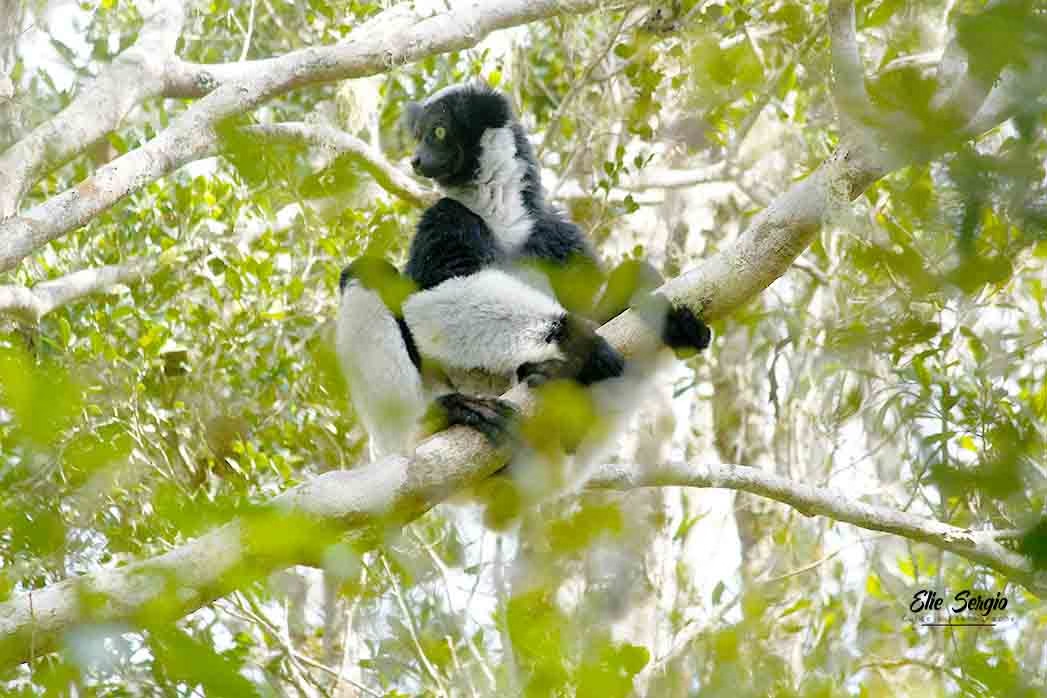
One island on Earth continues to baffle scientists with wildlife found nowhere else and evolutionary patterns that defy explanation. Isolated for millions of years, its animals and plants evolved without competition, predators, or parallel ecosystems. This in-depth guide explores why this island’s biodiversity is so extraordinary, what science still can’t fully explain, and why its preservation matters to the entire planet.
Why Are Americans Suddenly Searching for “Wildlife Scientists Can’t Explain”?
In recent years, search behavior in the U.S. has shifted toward curiosity-driven science and nature topics. Queries like “animals scientists can’t explain,” “weird island wildlife,” “unique ecosystems,” and “evolution mysteries” have surged across Google and YouTube.
This interest isn’t accidental.
As technology explains more of our world, people are increasingly drawn to places that still feel unresolved—locations where nature hasn’t followed predictable rules. Islands, in particular, capture attention because isolation creates conditions where evolution can take unexpected paths.
Among all islands on Earth, one stands above the rest as the greatest evolutionary puzzle ever studied.
Which Island Has Wildlife Scientists Still Can’t Fully Explain?
That island is Madagascar.
Located off the southeastern coast of Africa, Madagascar separated from the African mainland approximately 88 million years ago. Since then, it has evolved in near-total isolation—longer than almost any other large landmass on Earth.
According to data from the World Wildlife Fund (WWF) and National Geographic:
- Over 90% of Madagascar’s wildlife is endemic
- More than 80% of plant species exist nowhere else
- Entire animal families evolved only on this island
In evolutionary terms, Madagascar isn’t just different—it’s statistically extreme.
What Makes Madagascar’s Wildlife So Difficult to Explain?
Most islands develop unique species over time, but Madagascar goes far beyond typical island evolution.
Scientists understand the basics of geographic isolation. What they struggle with is scale and speed.
Madagascar’s animals didn’t just diverge—they diversified rapidly, filled unusual ecological roles, and evolved traits rarely seen elsewhere.
Where standard evolutionary models fall short:
- Large land mammals never arrived, yet ecosystems thrived
- Small animals evolved to fill roles normally occupied by predators
- Species adapted to hyper-specific microhabitats
- Entire evolutionary lineages formed in isolation
In short, Madagascar didn’t follow the usual script.
Lemurs: Primates That Redefined Evolutionary Expectations
No discussion of Madagascar’s mystery begins anywhere but with lemurs.
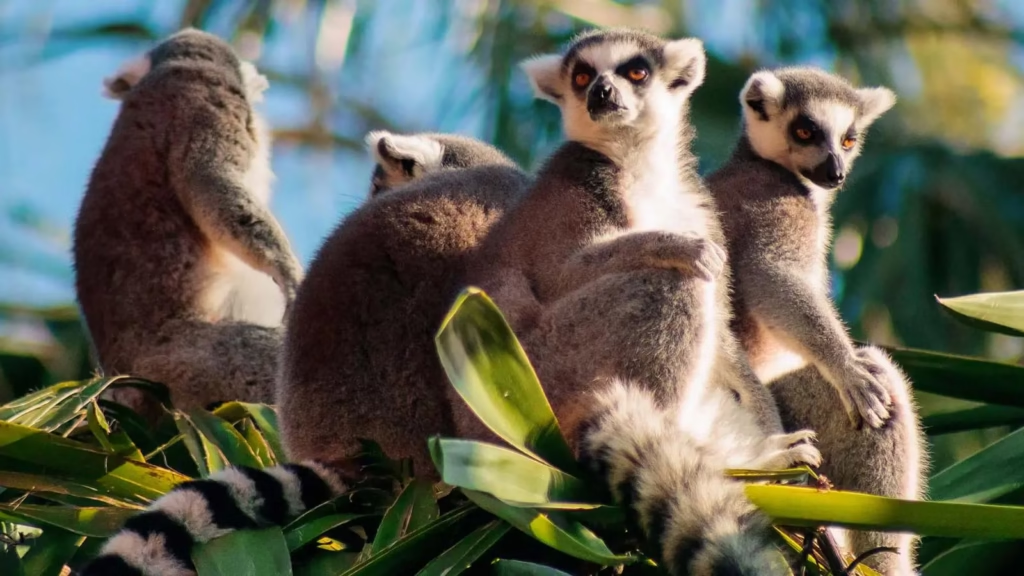
There are over 100 species of lemurs, all native exclusively to Madagascar. No wild lemur populations exist naturally anywhere else on Earth.
The prevailing theory suggests that early lemur ancestors arrived by rafting across the ocean on floating vegetation. While possible, the odds of such an event succeeding—and leading to such diversity—remain extraordinarily low.
Once lemurs arrived, something remarkable happened.
With no monkeys, apes, or large predators competing with them, lemurs diversified into dozens of species, filling ecological roles typically spread across many animal groups.
Why lemurs puzzle scientists:
- Rapid adaptive radiation
- Highly specialized diets and behaviors
- Social structures unseen in other primates
Some lemurs became nocturnal specialists. Others evolved to pollinate plants or disperse seeds—roles rarely associated with primates.
Madagascar’s Top Predator Isn’t What You’d Expect
Madagascar lacks lions, leopards, and wolves—yet it still has an apex predator.
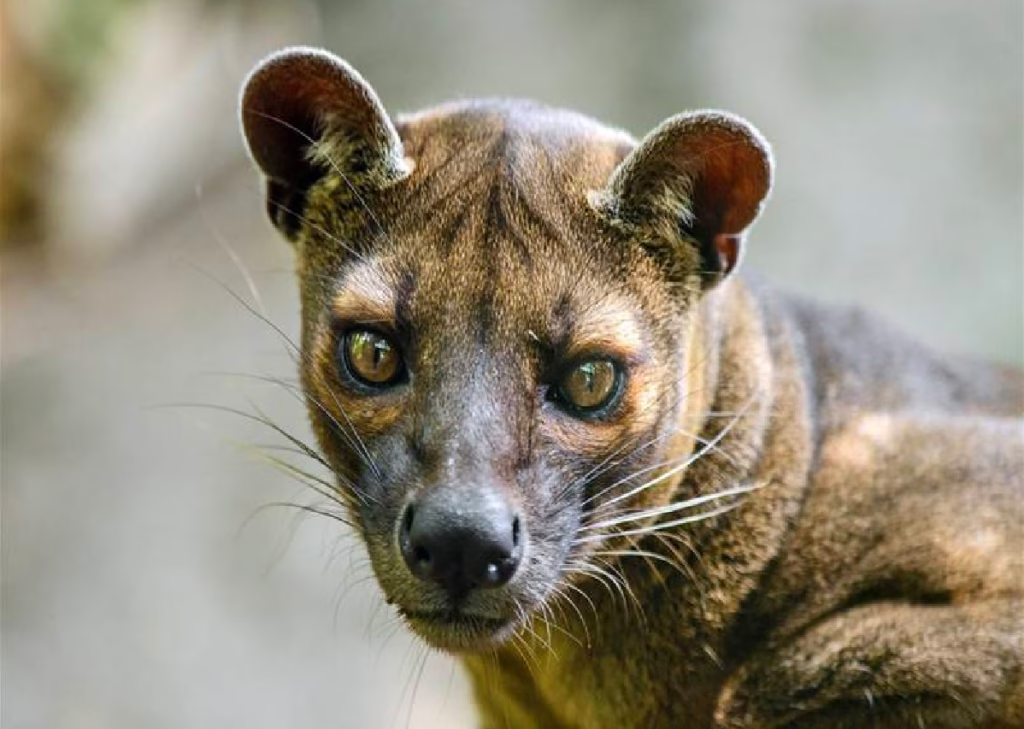
The fossa looks vaguely feline but behaves unlike any cat. Genetically, it belongs to a family of carnivores related to mongooses, yet it hunts lemurs in trees with extraordinary agility.
Scientists long debated how to classify the fossa because it combines traits that don’t normally coexist.
What makes the fossa so unusual:
- Tree-climbing predator without feline ancestry
- Body structure adapted for both ground and canopy
- No close ecological equivalent elsewhere
It evolved to dominate a niche that doesn’t exist outside Madagascar.
Reptiles That Push the Limits of Biology
Madagascar is home to more than half of the world’s chameleon species, including the smallest known reptile on Earth.
Some of these animals are so tiny they can comfortably stand on the tip of a finger.
What confounds scientists isn’t just their size—it’s how quickly they evolved. Research from institutions like the Smithsonian indicates that Madagascar’s reptiles adapted to extremely localized environments, sometimes within a few square miles.
Unique reptile traits include:
- Extreme miniaturization
- Highly specialized camouflage
- Rapid genetic divergence
In some regions, two distinct species exist on opposite sides of a single hill.
Plants That Evolved for Animals That No Longer Exist
Madagascar’s evolutionary mystery extends beyond animals.
Many of its plants evolved in direct response to animals that are now extinct—particularly giant lemurs that once roamed the island thousands of years ago.
Some trees produce massive seeds that modern animals struggle to disperse. Scientists believe these plants evolved alongside large herbivores that no longer exist, leaving behind evolutionary traits without a clear purpose today.
These are known as ecological anachronisms—features that made sense once, but no longer do.
Why Madagascar Has No Equivalent Anywhere Else on Earth
Other famous islands, like the Galápagos or New Zealand, also host unique wildlife. But Madagascar operates on an entirely different scale.
What sets Madagascar apart:
- It’s the fourth-largest island on Earth
- It has been isolated longer than most islands
- It contains rainforests, deserts, mountains, and coastlines
- It lacks large competing mammals
Together, these factors created an evolutionary environment scientists cannot easily replicate or model.
What Scientists Say About Madagascar’s Uniqueness
Evolutionary biologists often describe Madagascar as a living laboratory.
Studies published in journals such as Nature and Science acknowledge that traditional evolutionary frameworks struggle to explain the island’s biodiversity patterns.
Even with advanced genetic sequencing, many evolutionary relationships remain unclear.
In simple terms:
Science can explain parts of Madagascar’s story—but not the whole picture.
Why This Island’s Wildlife Is in Serious Danger
Madagascar’s uniqueness also makes it incredibly fragile.
According to WWF estimates:
- Over 90% of original forest cover has been altered
- Dozens of species face extinction within decades
- Habitat loss is the primary threat
Because these species exist nowhere else, extinction here is permanent.
Can Travelers Experience Madagascar’s Wildlife Responsibly?
Yes—but it requires thoughtful planning.
Eco-tourism plays an increasingly important role in funding conservation efforts when done responsibly.
Responsible travel practices include:
- Visiting protected reserves
- Hiring local guides
- Supporting conservation-based lodges
- Avoiding wildlife exploitation
When done correctly, tourism can help protect what science is still trying to understand.
Why Visiting Madagascar Changes How People See Nature
Many visitors say Madagascar feels less like a destination and more like another version of Earth.
Animals behave differently. Forests feel ancient. Silence carries weight.
It challenges the idea that humans fully understand the natural world—and reminds us that evolution is still unfolding.
Frequently Asked Questions
1. Which island has wildlife scientists can’t fully explain?
Ans. Madagascar is widely considered the island with the most scientifically puzzling wildlife due to its extreme endemism and isolation.
2. Why is Madagascar’s wildlife so unique?
Ans. Millions of years of isolation, lack of competing mammals, and diverse climates allowed species to evolve independently.
3. Are lemurs found naturally anywhere else?
Ans. No. All wild lemur species are native exclusively to Madagascar.
4. Are scientists still discovering new species there?
Ans. Yes. New species of reptiles, insects, and plants are discovered almost every year.
5. Why didn’t large predators evolve on Madagascar?
Ans. Large carnivorous mammals never reached the island due to geographic isolation.
6. Is Madagascar safe for wildlife tourism?
Ans. Yes, when travelers use reputable, conservation-focused tour operators.
7. How does Madagascar compare to the Galápagos Islands?
Ans. Madagascar is much larger, older, and biologically more diverse.
8. Are Madagascar’s species at risk of extinction?
Ans. Yes. Habitat loss and deforestation pose serious threats.
9. Can extinct species from Madagascar be replaced?
Ans. No. Because they were endemic, extinction is irreversible.
10. Why does Madagascar matter to science?
Ans. It helps scientists understand evolution, adaptation, and ecosystem resilience.
Final Reflection: A Mystery the World Still Needs
Madagascar reminds us that the natural world is not fully understood—and may never be.
Its wildlife challenges scientific assumptions, reshapes evolutionary theory, and proves that mystery still exists on Earth. The question is no longer whether this island is unique, but whether humanity will protect it long enough to keep learning from it.
Some mysteries deserve awe.
This one deserves protection.






Leave a Reply