
Some islands clearly appear on global maps yet have no permanent residents—a reality that feels almost impossible in today’s connected world. From extreme environmental conditions and strict legal protections to failed settlements and geopolitical tensions, this in-depth article explains why certain islands remain empty, what they reveal about humanity’s limits, and why Americans are increasingly fascinated by places where no one lives.
Why Are Americans Suddenly Fascinated by Islands Where Nobody Lives?
In recent years, Americans have begun searching unusual but telling questions online: “Why does nobody live on this island?” “Uninhabited island on Google Maps,” and “Is there land no one lives on?” These searches reflect a deeper cultural shift. In a world defined by population growth, urban density, constant connectivity, and digital saturation, the idea that entire islands remain untouched feels both shocking and strangely comforting.
For many readers, these islands symbolize escape. They represent places beyond traffic, algorithms, rent, and noise. But beneath the romanticism lies a more complex reality. These islands are not empty by accident. Their isolation, danger, legal status, and history explain why no permanent human footprint exists.
Understanding why these islands appear on maps yet remain uninhabited reveals as much about human ambition as it does about nature’s power.
What Does It Actually Mean When an Island “Appears on Maps”?
When people see an island on Google Maps or in an atlas, they often assume it must be livable. In reality, mapping only confirms geographic existence, not suitability for human life.
An island appears on maps when:
- Its landmass rises consistently above sea level
- It has been verified by satellite imagery or exploration
- It has been officially named or cataloged by a government or scientific authority
Mapping does not evaluate weather stability, freshwater access, soil quality, or long-term survival conditions. Many islands that look peaceful from space are among the most hostile environments on Earth.
The Real-World Example That Explains Everything: Bouvet Island
If one island perfectly explains why mapped land can remain empty, it is Bouvet Island.
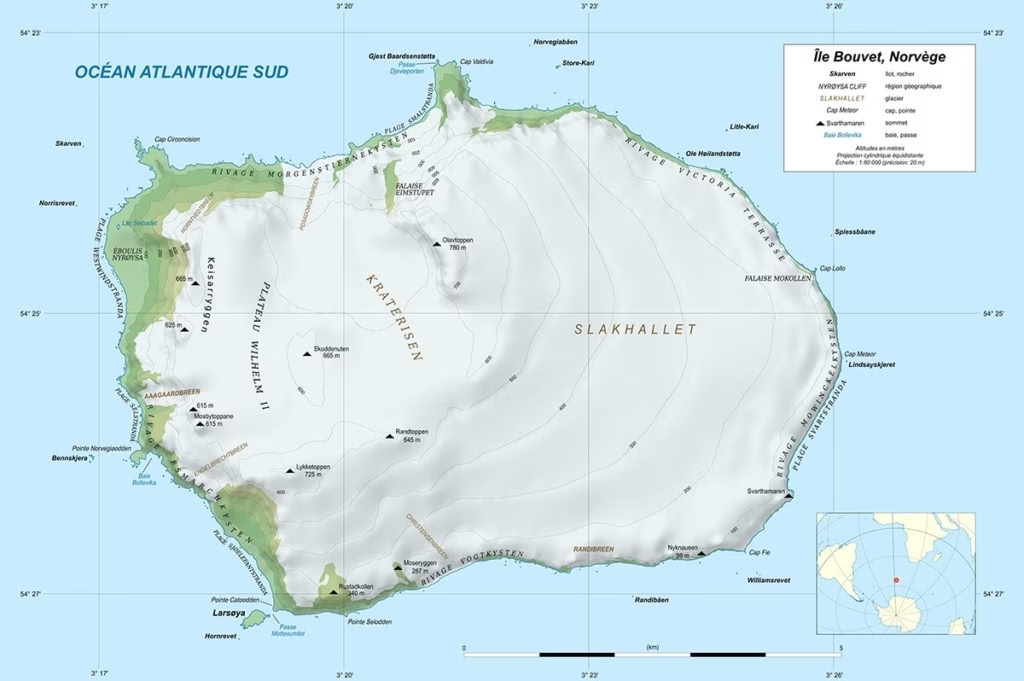
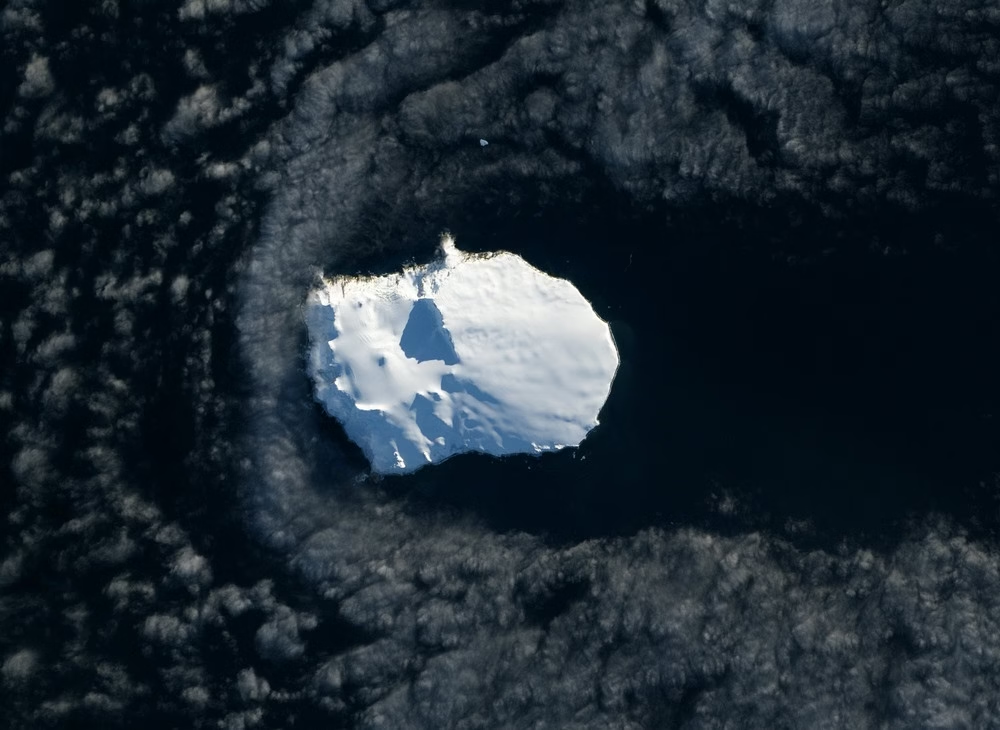
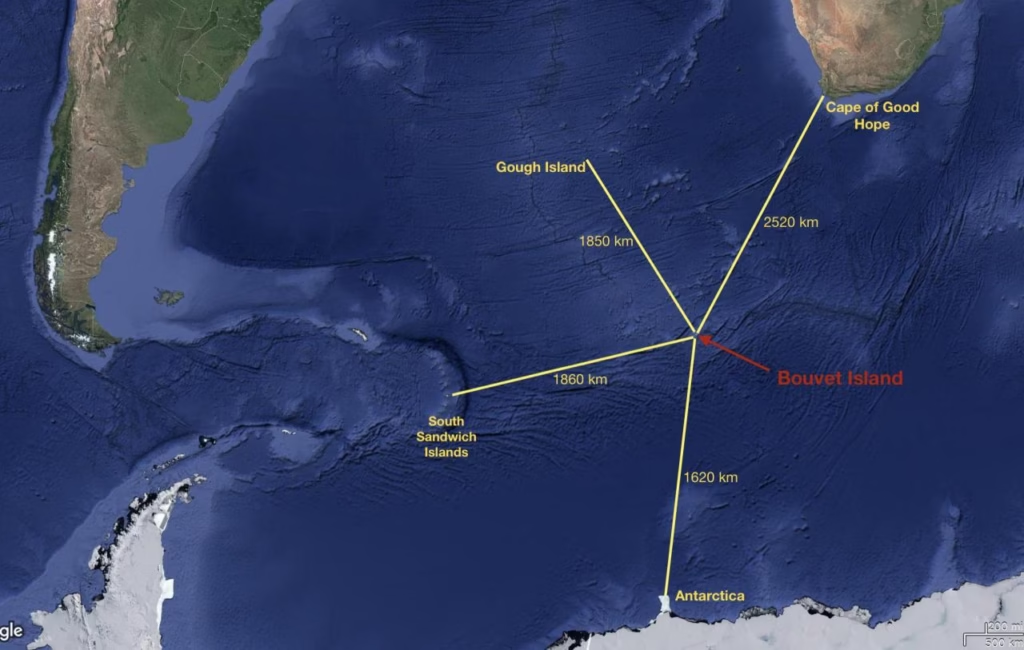
Located in the South Atlantic Ocean, Bouvet Island is officially a Norwegian territory. It appears clearly on global maps, yet it is widely recognized as the most isolated island on Earth. There are no towns, no residents, and no permanent research stations.
Why has no one stayed?
Bouvet Island is more than 90% covered by glaciers. It has no natural harbor, making landing extremely dangerous. Winds regularly reach hurricane strength, and freezing temperatures dominate year-round. There are no rivers, no lakes, and no reliable freshwater sources. Even modern research teams visit only briefly, often leaving behind automated instruments instead of people.
Despite human technology, Bouvet Island remains beyond sustainable settlement.
Are These Islands Empty by Accident — or by Design?
One of the biggest misconceptions is that uninhabited islands are simply “forgotten.” In truth, many are intentionally left empty.
Across history, humans attempted to colonize remote islands for trade routes, military advantage, or resources. Many of these attempts ended in failure. Others were abandoned when their environmental or economic costs became clear.
Today, governments and international organizations are far more cautious. Experience has shown that some ecosystems collapse quickly under human pressure. As a result, many islands are now protected rather than developed.
Environmental Extremes That Make Human Life Impossible
Some islands are uninhabited for one simple reason: survival is nearly impossible.
Environmental barriers often include:
- Active volcanoes and unstable ground
- Lack of drinkable freshwater
- Constant storms or dangerous ocean currents
- Extreme cold or heat
- Toxic gases or poor air quality
Heard Island: A Living Volcano
Heard Island, an Australian territory near Antarctica, is home to one of the world’s most active volcanoes. Glaciers cover most of its surface, and violent weather systems dominate the region. No permanent settlement has ever succeeded there, despite scientific interest.
Nature, in these cases, draws a clear boundary humans cannot cross.
Legal Protection: When Humans Are Not Allowed to Stay
In the modern era, many islands remain uninhabited because law prohibits settlement.
Island ecosystems are incredibly delicate. According to the United Nations Environment Programme, islands host a disproportionate amount of the world’s biodiversity. Human activity often leads to invasive species, habitat destruction, and irreversible damage.
As a result, many islands are designated as:
- Wildlife sanctuaries
- Marine protected areas
- Scientific research zones
- Restricted military or conservation territories
Palmyra Atoll: Protected, Not Abandoned
Palmyra Atoll, a U.S. territory in the Pacific, appears on maps but has no permanent residents. It is jointly managed by the U.S. Fish & Wildlife Service and The Nature Conservancy. Strict regulations limit human presence to protect coral reefs and seabird populations.
In this case, emptiness is a deliberate choice.
Political Disputes and Strategic Silence
Some islands remain empty because occupying them would create conflict.
Throughout the world, small islands sit at the center of overlapping territorial claims. Rather than risk diplomatic escalation, countries sometimes leave these islands uninhabited while maintaining legal claims.
In other cases, islands serve as:
- Surveillance locations
- Military buffer zones
- Strategic no-man’s-lands
Civilian settlement is avoided not because it’s impossible—but because it’s politically dangerous.
Islands That Were Once Lived On — And Then Abandoned
Not all uninhabited islands were always empty. Some tell powerful human stories.
Hashima Island: A City That Vanished
Hashima Island, off the coast of Japan, was once one of the most densely populated places on Earth. Built around coal mining, it housed thousands of residents in concrete apartment blocks.
When the coal industry collapsed in the 1970s, the island was abandoned almost overnight. Today, it still appears on maps but stands empty, its buildings slowly decaying. Hashima is a stark reminder that human presence is temporary—even when infrastructure seems permanent.
Phantom Islands: When Maps Lie
Some islands appear on maps even though they do not exist at all.
These so-called phantom islands originated from:
- Navigation errors by early explorers
- Optical illusions caused by clouds or icebergs
- Incorrect coordinates copied across generations of maps
In one famous case, an island remained on official charts for over a century before modern satellite imagery confirmed it had never existed.
Maps, like humans, can make mistakes.
Why These Empty Islands Fascinate Modern Americans
The emotional pull of uninhabited islands is no accident.
Psychologists suggest that as daily life becomes more crowded, monitored, and algorithm-driven, people crave the idea of places untouched by systems. An island with no people represents freedom, mystery, and limits to human control.
It challenges the assumption that humanity dominates every inch of Earth.
Could Humans Ever Live on These Islands in the Future?
Technologically, humans could survive almost anywhere—for a price.
However, the barriers remain significant:
- Massive infrastructure costs
- Ethical concerns about ecosystem destruction
- Legal restrictions
- Climate instability
In most cases, experts agree that development would cause more harm than benefit. Some places are valuable precisely because humans are absent.
What These Islands Teach Us About Our Planet
Uninhabited islands are not empty mistakes. They are living reminders that:
- Nature still defines boundaries
- Expansion has consequences
- Not every place must be occupied to have value
In a crowded world, these islands quietly prove that restraint can be just as powerful as exploration.
Key Takeaways
- Islands can appear on maps without being livable
- Environmental extremes often prevent settlement
- Many islands are protected by law
- Some were abandoned after human failure
- A few never existed at all
- Their emptiness reveals humanity’s limits
Frequently Asked Questions
1. Why does this island show up on maps if nobody lives there?
Ans. Maps document geographic features, not population. An island can be officially recognized even if it is uninhabitable or legally protected.
2. Are there islands humans are not allowed to live on?
Ans. Yes. Many islands are protected wildlife reserves, military zones, or conservation areas where settlement is prohibited by law.
3. What is the most isolated uninhabited island in the world?
Ans. Bouvet Island is widely considered the most isolated, located over 1,000 miles from the nearest landmass.
4. Can tourists visit uninhabited islands?
Ans. Some allow limited visits with permits, but many are completely restricted to protect ecosystems or for security reasons.
5. Do uninhabited islands belong to countries?
Ans. Most do. Even without residents, islands are often claimed and governed by nations.
6. Are there islands that appear on maps but don’t exist?
Ans. Yes. Phantom islands remained on maps due to historical navigation errors before satellite verification corrected them.
7. Why don’t governments develop these islands?
Ans. Development is often too expensive, environmentally harmful, or politically risky to justify.
8. Could climate change erase these islands?
Ans. Low-lying islands are vulnerable to rising sea levels and erosion caused by climate change.
9. Are uninhabited islands useful for science?
Ans. Extremely. They provide rare ecosystems for studying climate change and biodiversity without human interference.
10. Is there any island humans have never visited?
Ans. Possibly. Some remote Antarctic and sub-Antarctic islands may never have had documented human landings.





Leave a Reply