

Getting approved for a premium credit card in 2026 is no longer just about having a high credit score. Banks now evaluate income stability, credit structure, spending behavior, and existing relationships before approving elite cards. This insider guide reveals real-world strategies, timing secrets, and approval techniques used by successful applicants to secure premium cards faster—without unnecessary denials or credit damage.
Why Is It Harder to Get Approved for Premium Credit Cards in 2026?
If you feel premium credit cards are harder to get in 2026, you’re absolutely right.
Over the last few years, banks have quietly tightened approval standards for high-limit, high-fee cards. According to consumer credit data published by the Federal Reserve, lenders have become more selective with revolving credit products that carry larger risk exposure—especially premium cards with generous benefits and travel protections.
This shift isn’t about punishing responsible borrowers. It’s about risk management.
Premium cards:
- Offer higher credit limits
- Carry expensive perks
- Attract frequent travelers and high spenders
From a bank’s perspective, approving the wrong applicant can be costly. As a result, issuers now prioritize predictability and long-term profitability over surface-level metrics like credit score alone.
What Do Banks Actually Look for When Approving Premium Cards?
One of the biggest myths about premium card approval is that a single number—your credit score—decides everything.
In reality, issuers evaluate your application through a multi-factor risk model.
They assess:
- Credit score trends (not just the latest score)
- Income consistency and reliability
- Existing total credit exposure
- Recent application behavior
- Past relationship with the bank
For example, two applicants may both have a 740 credit score. One gets approved instantly, while the other gets denied. Why? Because the approved applicant has stable income, low utilization, and a long-standing relationship with the issuer.
Banks reward patterns, not snapshots.
What Counts as a “Premium Credit Card” in 2026?
In 2026, a premium credit card is defined less by branding and more by financial responsibility requirements.
Most premium cards share these characteristics:
- Annual fees typically above $500
- High or uncapped credit limits
- Travel and lifestyle benefits
- Enhanced purchase and travel protections
These cards are designed for consumers who:
- Spend consistently
- Pay reliably
- Use credit as a tool—not a crutch
Issuers expect premium cardholders to be low-risk, high-value customers over many years.

Credit Score Myths: Why 800 Isn’t the Magic Number
Many applicants delay applying because they believe they need an 800+ credit score.
That belief is outdated.
In practice:
- Many premium card approvals happen between 700–740
- Some denials occur above 780
Why? Because banks care more about credit structure than peak score.
What Matters More Than a Perfect Score
- Low overall credit utilization (ideally under 10%)
- No recent late payments
- Long average account age
- Healthy balance between income and credit limits
A borrower earning $120,000 annually with $12,000 total credit exposure often looks safer than someone earning $70,000 with $50,000 exposure—even if both have similar scores.
How Income Impacts Approval (And Why Reporting It Correctly Matters)
Income is one of the most powerful—but misunderstood—approval factors.
Banks don’t just ask how much you earn. They assess:
- Stability of income
- Predictability of cash flow
- Ratio of income to total credit exposure
Real-life example:
A dual-income couple in California earns $190,000 combined but reports only one income stream during application. The application is denied. After updating household income during reconsideration, the approval is granted immediately.
Always report eligible income accurately, including:
- Base salary
- Bonuses
- Commissions
- Household income (when allowed)
Why Existing Credit Limits Can Quietly Hurt Your Approval
This is one of the least discussed but most important insider rules.
Every bank has an internal maximum exposure threshold per customer. If approving your new card pushes you beyond that threshold, you may be denied—even with excellent credit.
What You Can Do:
- Close unused high-limit cards
- Request credit limit reductions
- Reallocate limits during reconsideration
Many approvals that initially fail are later approved simply by shifting existing credit rather than extending new exposure.
Timing Your Application: When Matters as Much as Who
Even strong applicants get denied when they apply at the wrong time.
Strategic timing can dramatically improve approval odds.
Best Times to Apply:
- After balances report low
- After an income increase or promotion
- When you have fewer than 2 inquiries in 6 months
- During issuer promotion cycles
Credit bureau data shows applicants with minimal recent inquiries are statistically more likely to receive premium approvals.
Why Bank Relationships Matter More Than Ever
Banks strongly prefer applicants they already know.
Existing relationships signal:
- Stability
- Predictable behavior
- Lower fraud risk
Relationships that help include:
- Checking or savings accounts
- Existing credit cards
- Investment or brokerage accounts
Real-life example:
A Florida-based consultant was denied twice as a new applicant. After opening a basic checking account and routing direct deposits for three months, approval was granted without hesitation.
Banks value relationship depth.
Spending Behavior: The Approval Signal Most People Ignore
Issuers analyze how you use credit—not just whether you pay it.
They favor customers who:
- Spend consistently
- Use a moderate percentage of available credit
- Pay balances responsibly
Surprisingly, people who never use their credit can appear less attractive than those who demonstrate healthy, predictable usage.
Premium cards are designed for active users, not dormant accounts.
Common Mistakes That Instantly Kill Approval Chances
Many denials are completely avoidable.
High-Impact Mistakes to Avoid:
- Applying with high utilization
- Applying during job changes
- Submitting multiple applications quickly
- Underreporting income
- Ignoring reconsideration calls
A denial is often a request for clarification—not a final verdict.
Reconsideration Calls: Where Premium Approvals Are Won
This is the biggest secret in premium card approvals.
A reconsideration call allows you to:
- Explain recent inquiries
- Update income details
- Reallocate credit lines
- Demonstrate responsible intent
Many premium approvals happen after an initial denial, simply because the applicant took the time to speak with a human reviewer.
Calm, professional communication goes a long way.
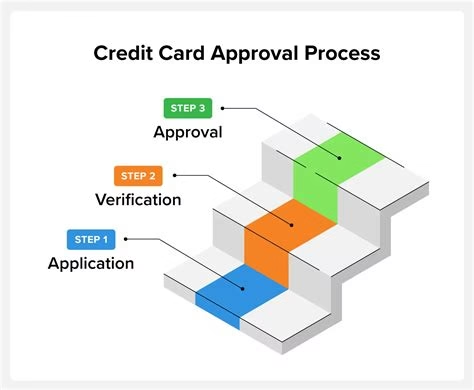
How Fast Can You Really Get Approved?
With preparation, premium card approvals can happen:
- Instantly through automated systems
- Same day after manual review
- Within 48–72 hours via reconsideration
The fastest approvals always come from prepared applicants.
Pre-Application Checklist for 2026
Before applying:
- Pay balances below 10%
- Avoid new credit for 30 days
- Verify income information
- Review issuer-specific rules
- Prepare reconsideration talking points
This checklist alone can dramatically improve approval odds.
Frequently Asked Questions
1. What credit score do you need for a premium card in 2026?
Ans. Most approvals happen between 700–740, though income and credit structure matter more than score alone.
2. Can I get approved for a premium card quickly?
Ans. Yes. With proper timing and preparation, approvals can happen instantly or within a few days.
3. Does income matter more than credit score?
Ans. For premium cards, income stability and credit exposure often matter more than the score itself.
4. Can recent inquiries hurt approval?
Ans. Yes, but spacing inquiries and explaining them during reconsideration can still lead to approval.
5. Should I close cards before applying?
Ans. Closing unused high-limit cards can reduce exposure and improve approval odds.
6. Are premium cards harder to get in 2026?
Ans. Yes. Issuers have tightened standards, making strategy more important than ever.
7. Does having a bank account help approval?
Ans. Absolutely. Existing relationships significantly increase approval chances.
8. Do reconsideration calls really work?
Ans. Yes. Many premium approvals happen after a successful reconsideration call.
9. Is it smart to apply right after a raise?
Ans. Yes. Applying after an income increase can materially improve approval odds.
10. What’s the biggest mistake to avoid?
Ans. Applying with high utilization or during major financial transitions like job changes.
Final Takeaway: Premium Approval Is a Strategy, Not Luck
In 2026, getting approved for a premium credit card isn’t about prestige—it’s about positioning.
The applicants who get approved fastest aren’t necessarily the richest or the highest-scoring. They’re the ones who understand how banks think and prepare accordingly.
When you apply with the right timing, structure, and confidence, premium approval stops being uncertain—and becomes predictable.





Leave a Reply